Sealing Flat Roofs – How to Achieve Reliable Waterproofing


Waterproofing is one of the most critical steps in flat roof construction – even small mistakes can lead to serious moisture damage. This article shows how flat roof waterproofing is professionally planned, executed and maintained over the long term.


Reading time: ca. 9 min.

Why Waterproofing Is So Crucial on Flat Roofs

Unlike pitched roofs, flat roofs can only drain rainwater very slowly. Even minor leaks can quickly lead to moisture damage in the insulation or load-bearing structure. Particularly dangerous are fine hairline cracks, which can enlarge over time due to temperature fluctuations and UV radiation. A durable flat roof waterproofing system, correctly installed, ensures that the roof remains permanently watertight and retains its durability – even under standing water, frost and mechanical loads.

How long does a flat roof last? A professionally waterproofed flat roof has a service life of 25 to 50 years, depending on the materials used.

The Correct Flat Roof Build-Up – The Basis of Every Waterproofing System

A watertight roof build-up is the foundation of any flat roof waterproofing. Only when all layers are properly coordinated will the roof remain watertight in the long term.

A typical flat roof build-up consists of the following components:

  1. Load-bearing structure – usually concrete, timber or trapezoidal sheet metal
  2. Vapour barrier – prevents indoor moisture and condensation from penetrating
  3. Thermal insulation – ensures energy efficiency and temperature stability
  4. Waterproofing layer – acts as the water-bearing layer protecting against moisture
  5. Protective or gravel layer – provides UV and weather protection

Particularly important is the roof fall: according to flat roof guidelines, it must be at least 2% to ensure reliable drainage. Incorrect or uneven falls often result in standing water, which places long-term stress on the waterproofing and may cause damage.

Materials and Systems for Flat Roof Waterproofing

So, what is the best way to waterproof a flat roof? Every flat roof is different – and the same applies to waterproofing. The choice of material depends on roof use, weather exposure, roof build-up and budget. Below is an overview of the most common flat roof waterproofing materials.

Bitumen Membranes – Proven Waterproofing with Tradition

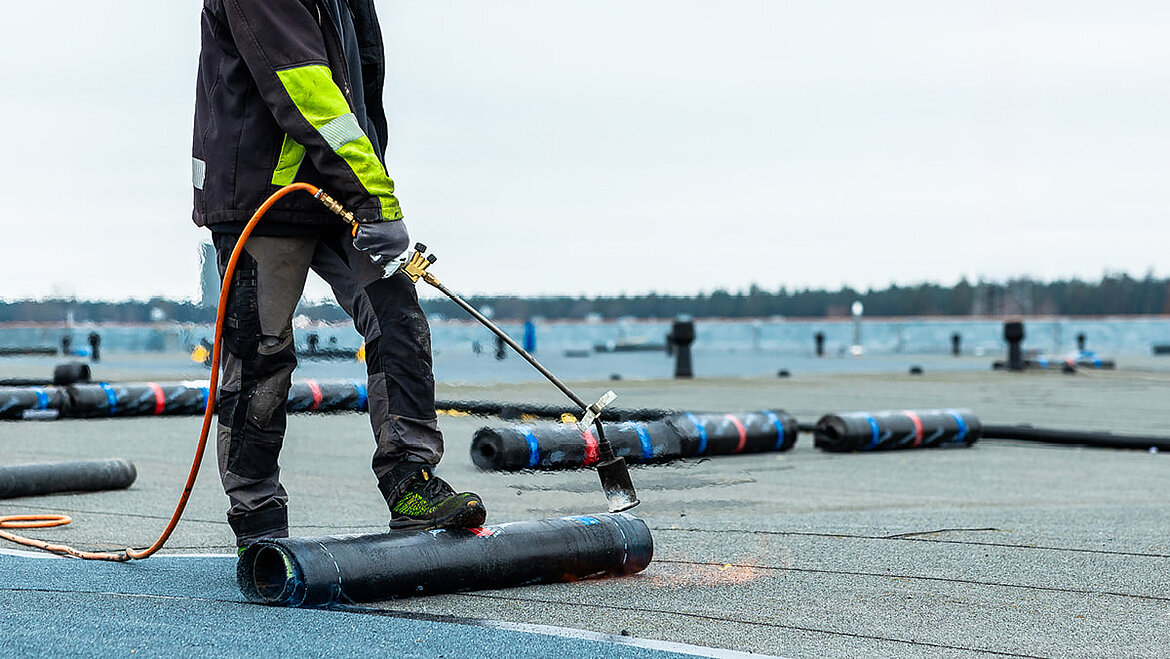
Bitumen membranes have been the standard material for flat roofs for decades. Made from polymer-modified bitumen, they are usually installed in two layers and bonded by hot welding or cold adhesion. The result is a particularly robust, elastic and durable waterproofing layer.

Advantages:

  • Proven system with decades of experience
  • High mechanical resistance
  • Easy to repair or upgrade

Bitumen membranes are ideal for large roof areas, industrial buildings and garages. Their typical service life is 25 to 30 years, significantly longer with regular maintenance.
 

Liquid Waterproofing – Durable and Ideal for Detail Areas

When it comes to complex connections, penetrations or rooflights, liquid waterproofing is often the material of choice. It is applied in liquid form, cures seamlessly and forms an elastic, joint-free waterproofing layer.

The material adheres to almost all substrates – from concrete and bitumen to metal – and is suitable for both new builds and refurbishments.
Advantages:

  • Seamless, joint-free and fully bonded
  • Permanently elastic and UV-resistant
  • Ideal for complex detailing

A major benefit is its versatility: liquid waterproofing can be used as a full waterproofing system or as an emergency or refurbishment solution for leaking roofs. Upstands and rooflights can also be sealed particularly well using this method.

Professional tip: Ensure system-compatible reinforcement fleece is used – only then can the waterproofing permanently bridge cracks.
 

PVC Roof Membranes – Lightweight and Economical Plastic Waterproofing

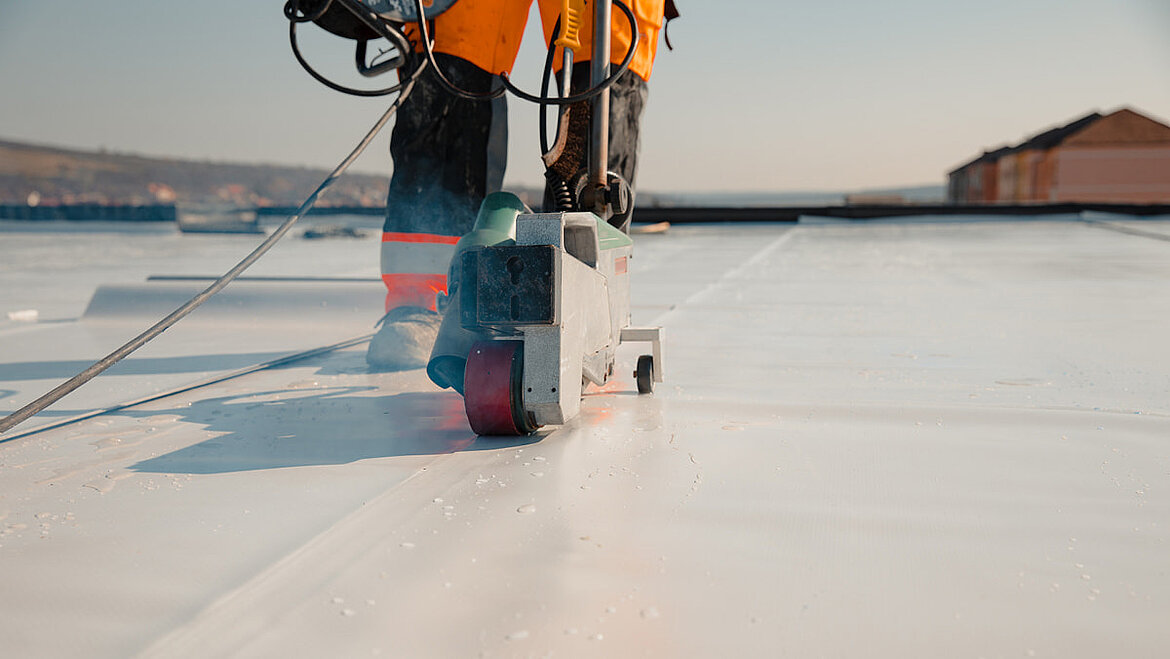
PVC roof membranes (polyvinyl chloride) have been a proven flat roof waterproofing material for many years. They are usually installed in a single layer, hot-air welded and offer low weight combined with fast installation – ideal for large roof areas or refurbishments with limited load-bearing capacity.

PVC membranes consist of plasticised material with fabric reinforcement and offer good UV and weather resistance. They are suitable for mechanically fastened, ballasted or adhered systems and are particularly common on industrial and commercial roofs.

Advantages:

  • Lightweight, flexible and quick to install
  • Homogeneous seams created by hot-air welding
  • Cost-effective solution for large roof areas
     

Note: PVC is not compatible with bitumen. When refurbishing, a separation layer must always be installed between existing bitumen membranes and new PVC waterproofing.

EPDM Membranes – Long-Lasting, Flexible and Sustainable

Another flat roof waterproofing option is EPDM membranes. Made from synthetic rubber, they are exceptionally durable and often last over 50 years, remaining elastic even under extreme temperatures. As membranes are typically installed in large sheets, there are very few seams – a clear advantage over bituminous systems.

Advantages:

  • Long service life and minimal maintenance
  • Cold installation without open flame
  • High elasticity and flexibility
  • Environmentally friendly and recyclable

EPDM is suitable for both new builds and refurbishment projects – for example, when a flat roof is being re-waterproofed or an existing bitumen layer is to be overlaid.


Coatings – A Simple Solution for Flat Roof Refurbishment

Liquid-applied roof coatings based on PU, PMMA or silicone resin are particularly popular for refurbishment. They can be applied directly to existing waterproofing layers, forming a new watertight surface. These systems are a good option when repairs are required or when a complete renewal would be too complex or costly.

Properly Sealing Detail Areas – Roof Penetrations and Upstands

Most leaks do not occur on the main roof surface, but at detail areas. Roof penetrations, rooflights, drainage outlets or upstands can become typical weak points if waterproofing is not carried out professionally. Precise workmanship and suitable materials are therefore essential.

Professional tip:

Installer-friendly upstands for skylights – such as those from LAMILUX – provide practical support for professional waterproofing. Whether GRP surfaces suitable for liquid waterproofing or special PVC connection rails and clamping profiles, LAMILUX offers the right solution for every flat roof.

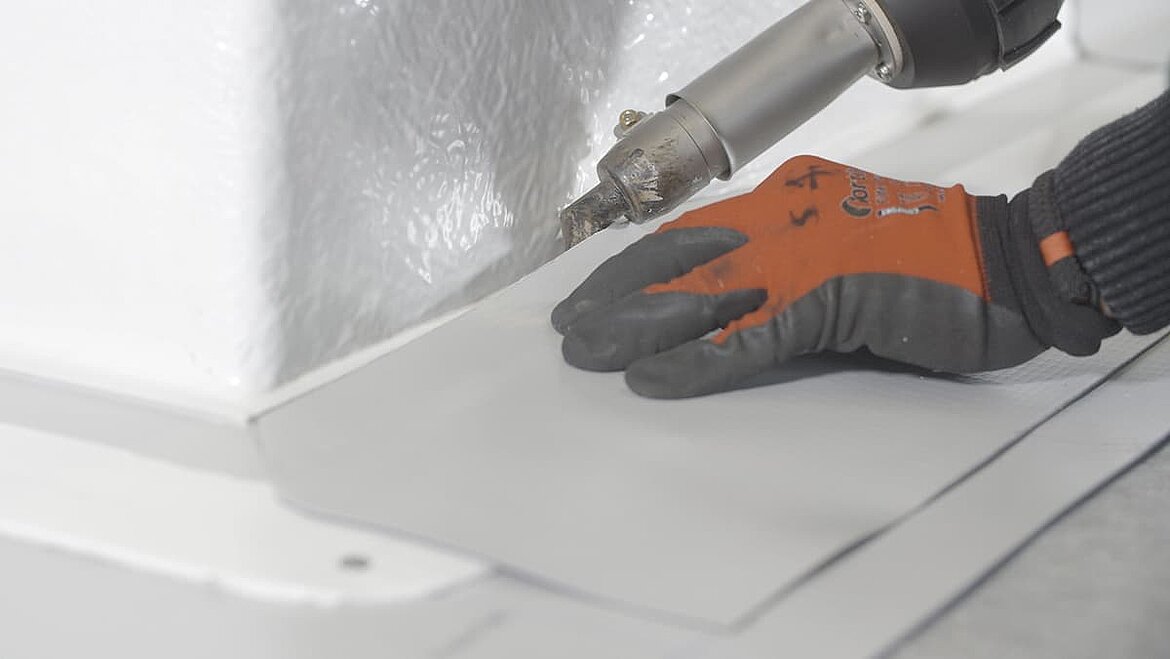
Hand with protective gloves welding roof membrane with hot air tool.

PVC connection to a rooflight

A clean, durable connection to the rooflight dome is essential for energy efficiency and airtightness. In this article, we show what really matters – explained step by step.

Get Practical Tips Now!

Sealing Flat Roofs – Step-by-Step Guide for Roofers

Checking the condition of the roof

Before waterproofing work begins, a thorough inspection of the roof surface is essential.

For new builds, the focus is on the substrate: the load-bearing structure (e.g. concrete slab or trapezoidal sheet) must be level, dry, clean and structurally sound. The position and height of outlets, upstands and rooflight upstands must be checked before work starts.

For refurbishment projects, the existing waterproofing is first assessed. Loose membranes, blisters, cracks or penetrations must be identified, marked and documented. In many cases, it is then decided whether the existing waterproofing can be removed, overlaid or reused as a separation layer.
 

Cleaning and preparing the roof

Even the best waterproofing system will fail if the substrate is not properly prepared. Dust, moss, leaves and loose particles must be thoroughly removed – ideally using brooms, vacuum cleaners or hot-air equipment. Damp areas must be completely dried before primers or new membranes are applied. Depending on the system, a bonding primer or separation layer may be required (e.g. PVC over bitumen).

Applying the waterproofing system

The selected waterproofing system is then installed:

  • Bitumen membranes are hot-welded or cold-adhered with 8–10 cm overlaps.
  • EPDM membranes are cold-bonded or mechanically fixed, with joints sealed using special adhesive or tape.
  • Liquid waterproofing is reinforced with fleece, applied in liquid form and cures seamlessly.
  • PVC membranes are hot-air welded and mechanically fixed.

All systems must be installed stress-free, wrinkle-free and with cleanly formed connections. Corners, penetrations and upstands are the most common weak points and require particular care.
 

Inspection and finishing work

After completion, a leak-tightness test is mandatory. Depending on roof size and system, suitable methods include:

  • Flood testing (classic for flat roofs)
  • Electronic leak detection (low-voltage method)
  • Thermography for moisture detection

In addition, seam overlaps, connections and edge details should be visually inspected. Only after successful inspection is the waterproofing considered complete. Finally, the surface may be finished with a protective layer, gravel or paving slabs, depending on the system design.

Practical tip:
Detailed photographic documentation of all work steps improves traceability – especially in the event of warranty claims.
 

Costs and Service Life of Flat Roof Waterproofing

The cost of waterproofing a flat roof depends largely on the material used, roof size and the level of work involved. On average, prices range between €30 and €70 per m².

Waterproofing systemCost per m² (approx.)Service life (approx.)
Bitumenbahnen€ 30–5025–30 years
PVC-Dachbahnen€ 30–5025–35 years
EPDM-Folie€ 40–6040–50 years
Flüssigkunststoff€ 50–7025–35 years
Beschichtungssysteme€ 25–4010–15 years

A professionally waterproofed flat roof can last several decades with regular maintenance. Especially for industrial buildings, garages and roof terraces, investing in high-quality materials and professional installation pays off in the long term.

Keeping Flat Roofs Permanently Watertight – Maintenance and Care

A watertight flat roof requires regular inspection, which is why a roof inspection at least once a year is recommended. During this process, drainage outlets should be cleaned, leaves, moss and standing water removed, and waterproofing layers checked for cracks or detachment. Emergency repair materials should also be kept readily available. This allows minor damage to be temporarily sealed quickly until a permanent repair can be carried out.